The current majestic brick building replaces a small (30′ x 60′) wooden frame church first built in 1872 on a lot adjacent to the present site. The land for the current location was purchased in January 1880; by May of the same year, under the first resident pastor, the Rev. John Browne, a rectory was built and the church was moved on site and enlarged.
The present building was planned by the Rev. Patrick O’Reilly, the second pastor. The cornerstone was laid on June 11, 1890 and the building was dedicated on November 30, 1893, having cost approximately $90,000 to complete.
The church was extensively renovated in 1955, when, among other things, air conditioning was installed. In 1972, structural repairs were effected and the sanctuary was re-ordered. In 1992, additional work was done in preparation for the Cathedral’s centennial. Most recently, a complete renovation of the exterior was finished in 2015.
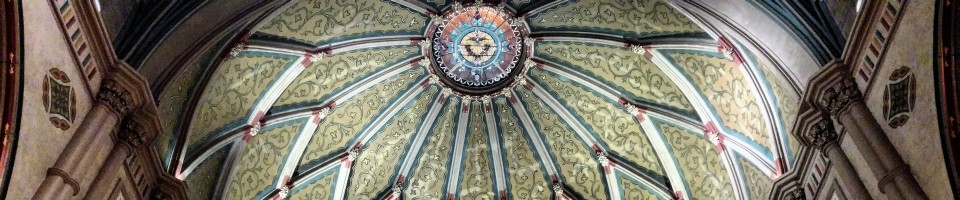
The Cathedral is widely considered to be a handsome example of the American variation on the neo-gothic style. Gothic architecture is philosophically Christian: in its determined verticality, the gothic structure pulls the eye to heaven and inspires the mind to lofty thoughts. The strong contrast of color on the Cathedral’s exterior, with the native red brick and white limestone of the walls, and the polychromatic banding in the slate roof, show the taste of the international gothic revival of the 1870s.
The main entrance has a central statue of Christ above the doors. Upon entering, one sees that the church is built in basilica form, having a semicircular domed apse at one end, with a center aisle and two side aisles. Ten solid granite columns support vaults and arches indicative of the neo-gothic style.
The baptismal font stands at the door of the church to remind those entering that Baptism is the doorway to faith and the life of the Church. Those who enter dip their hand in the Holy Water and mark themselves anew with the sign in which they were baptized – the sign of the Cross.
The central part of the church, extending from the entrance hall, or narthex, to the apse, is called the “nave” (from the Latin word for “boat”), and provides the assembly space for God’s people at prayer. There are two confessionals: one located immediately to the let upon entering through the central doors to the nave, and one down the right aisle, near the statue of Saint Joseph.
Around the walls of the nave are the 14 images known as the “Stations of the Cross”, depicting the final events in the life of Christ from the time when he was condemned to death, to his crucifixion and entombment. As a personal devotion, the faithful walk from station to station, meditating on each event of the Passion. This devotion is celebrated communally on the Fridays of Lent.
The statues of the Blessed Mother, St. Joseph, St. John Vianney, and St. Paul (all near the sanctuary) and St. Anthony of Padua (immediately to the right, in the back, upon entering the nave), as well as the images of various saints in the stained glass windows, serve as reminders to Catholics of the communion of saints. Thus we call to mind our union with the countless heroic Christians who have gone before us and who act as intercessors before the throne of God.
The Cathedral has a particularly beautiful altar, procured by its former pastor, Father Coyle, and carved out of carrara marble with Mexican onyx column accents. The central image on the altar is a bas relief of the Lamb of God seated on the Book with Seven Seals (from the Book of Revelation); this is complemented by reliefs of wheat and grapes on either side — references to the Holy Eucharist. The altar contains relics of three early martyrs: Saints Placidus, Theodorus, and Tarcisius.
St. Paul’s was originally a parish church of the Archdiocese of Mobile, later the Archdiocese of Mobile-Birmingham, with St. Paul’s becoming a Co-Cathedral. On December 9, 1969 the Holy See erected the Diocese of Birmingham in Alabama from territory that previously was part of the Archdiocese, and designated St. Paul’s as the Cathedral Church of the new Diocese. Bishop Joseph Vath was the first Bishop and served until his death in 1987 (his grave is located in the Cathedral courtyard).
The other graves in the courtyard next to the Cathedral, which has within it a beautiful outdoor altar depicting the Death of St. Joseph, are as follows: Bishop Vath’s successor, Bishop Raymond Boland (1988-1993), was buried in Ireland, but a marker recalls his service to the Diocese of Birmingham in Alabama, notes his actual burial spot, and remembers him in death. Bishop David Foley (1994-2005) succeeded Bishop Vath; he died in 2018 and is buried there as well.
Since the time of Bishop Foley we have had two bishops: Bishop Robert Baker served 2007-2020 and is currently Bishop Emeritus. Bishop Steven Raica was installed in June 2020 and is our current bishop.
The Bishop’s cathedra (or throne) is located in the sanctuary on the left side. It is surmounted by his coat of arms and only he may use this chair, which he does whenever presiding at a Cathedral liturgy.